CTMU — Enfer
ctmu philosophie métaphysique religion note-fouillis
Bernard, at this point in my study of the CTMU, I am struggling to find clear answers to two questions that, it seems to me, would have important implications for this issue of “ethical indifference”.
My two questions, illustrated with (apologetically long) quotes from Christopher Langan, are as follows, and I will subsequently explain why they seem rather crucial:
Quote
“In the CTMU, “what God thinks is right” is encapsulated by the Telic Principle. This principle, a generalization of the Cosmological Anthropic Principle, asserts that by logical necessity, there exists a deic analogue of human volition called teleology.
However, due to the fact that God’s Self-creative freedom is distributed over the universe, i.e. His “Mind”, human volition arising within the universe is free to be locally out of sync with teleology. This requires a set of compensation mechanisms which ensure that teleology remains globally valid despite the localized failure of any individual or species to behave consistently with it. In part, these mechanisms determine the state of your relationship to God, i.e. your soul. If you are in harmony with teleology — with the self-realization and self-expression of God — then your soul is in a state of grace. If you are not, then your soul is in danger of interdiction by teleological mechanisms built into the structure of the universe.”
— Christopher Langan, “CTMU Q&A: Moral Laws”, Mega Foundation Website (2005)
QUESTION 1:
If someone has not been sufficiently in harmony with teleology, does the resulting interdiction of his soul mean :
a) that a relatively painless and bearable process will cause him to permanently lose the ability to experience?
[no more experience]
b) that a process will cause him to experience at least one period of excruciating suffering, which will be only temporary but still unbearable (e.g. of the order of magnitude of burning alive for a year), before he permanently loses the ability to experience?
[experience of at least one temporary hell, then no more experience]
c) that a process will cause him to experience excruciating, unbearable and eternal suffering?
[experience of an eternal hell]
d) that a process will make him experience at least one period of excruciating suffering, which will only be temporary but unbearable, before rehabilitating him and making him return to a normal experience?
[experience of at least one temporary hell, then salvation]
Here are some words I found from Langan on this subject:
Quote
Question 1: “Some have said that atheists who deny God don’t make it to heaven, etc. How do you explain, then, atheists who had NDEs of heaven?”
Answer 1: It could mean either of two things.
- The atheist is merely confused about what he/she is, and is destined to see the light.
- The atheist is clear on his/her atheism, but destined to repudiate it and make amends.
Question 2: “Would Chris Hitchens be in hell? I hope not, or else, what of Hitler! Shove Hitler in hell, I don’t care, but save the Hitch. He was a good man, never murdered, etc. Why should he (in the Christian tradition) get eternal punishment?”
Answer 2:
“Yes, [Christopher] Hitchens could well be in hell, and is certainly in Hell if he didn’t reach a last-minute accommodation with God.
Bear in mind that salvation would have been quite costly for Hitchens — he wasn’t just an atheist, but an atheist who used fame, prominent associations, and a powerful media presence to turn others away from God.
[…]
Too bad Hitchens did that. If he’d kept an open mind and allowed me (or someone else) to convince him, he wouldn’t be in hell right now. But standing against Logos for that period of time, at a crucial juncture like this one, is not something for which Hitchens and his fellow travelers can be rewarded. Hitchens either groveled before God and begged forgiveness — and for his sake, I very much hope that he did — or Hitchens burns.”— Christopher Langan, CTMU Facebook Group (2020, June 24)
https://www.facebook.com/groups/ctmurealitytheory/posts/10158358668157486/
Quote
Curt: “Let’s speak about the concept of hell, can you define it?”
Langan: “That’s where Richie [Richard] Dawkins is going. laughter I’m just joking. Hell is simply the process of cessing to exist, of being telicly unbound and having your identity destroyed, because it is unacceptable to God. See… God… in the CTMU is something called the stratified identity, and God can be defined as the highest level of the stratified identity, the level that we all share with each other, we’re all united in God. But God is good, and he must exclude evil in order to preserve the integrity of his identity. This is what he does, so if you deny God and you cut your… you basically… you’re cutting your line of communication with God because you hate him so badly, then God can no longer see you, no longer wants to see you, and can no longer accept you into himself because he’s totally consistent, God is totally, completely self-consistent, and will not tolerate his denial. This is something that God can afford to tolerate, because something that is perfect can not tolerate, cannot absorb or simulate imperfection into himself. It can tolerate it for a while, but then after a while he’s got to exclude it. Alright, so this is what hell is. Basically your own highest level of identity is telling you : “you can no longer exist because you’re no longer in touch with me, you’ve cut your own identity in half, you’ve severed it”. It’s called the soul, the human soul, that’s what these… these levels of stratified identity are. They’re your soul, and once you… you interdict that, once you sever it, ok… you’re cut off from God, that way your own highest level of identity cannot communicate with you anymore, it can’t see you. So when you die and you beg on the death bed “please take me back in”, God can’t hear you anymore. That’s a terrible thing and I don’t wish it on anybody, but if people understand this, they understand the stratified identity, they understand what God is, namely their own highest level of identity, they won’t punish themselves with unbinding and destruction. Now because that’s a very unpleasant experience, everyboy wants to clean for their identity in the end. It’s hellish, people create their own hell, by rejecting their own highest level of identity.”
Curt: “There is this phrase, I don’t know where I got it from but, it says the hell is a prison locked from the inside.”
Langan: “That’s correct. Well that… that… that is… that’s a very good, very apposite quote.”
Curt: “Is it a place of torture? Is it a place of torment? Is it a place of infinite heat?
Langan: “Oh well you feel tortured and tormented, that’s for sure. And if your conception of hell is a place where there is a great deal of heat, then you gonna feel that too”.
Curt: “So you bring within your own idea of what hell is?”
Langan: “That’s correct. Where… Where else would they come from?”
Curt: “For someone like Dawkins who doesn’t believe in the concept of hell either, will he then experience nothingness?”
Langan: “Ok well… You know… You’re right, I probably shouldn’t pick on Richie Dakwins, he is what he is, but Richie Dawkins will create his own kind of hell. Alright, because he rejects… he rejects… He will create his own kind of hell, and that is probably going to be a hell where nobody pays any attention to him. Ok? He’s no longer a big shot at Oxford University, he can no longer run around telling people how much he hates God, nobody wants to listen to him anymore. That’s what will happen to Richie, that’s his hell, and then finally, in the end he’ll just be melted down to nothingness, and the telesis of which he constists will be redistributed through the rest of the universe.
[…]
They [New Atheists] have a physical body, they are basically cohering with their physical body, and that’s what providing them a continued identity. They reduce themselves out of pure physicality. There’s not much left there, they have actually cut off their highest level of identity, and that will affect them when they are retracted from the mortal play — you no longer have a body here that holds them together, then that’s it for them.”— Christopher Langan & Curt Jaimungal, “Chris Langan on IQ, The Singularity, Free Will, Psychedelics, CTMU, and God”, Theories of Everything with Curt Jaimungal Youtube Channel, 2:18:07, 2:27:15 (2021, July 14)
QUESTION 2:
If someone has not been sufficiently in harmony with teleology :
a) will he be the only one to suffer, because of his behaviour, the interdiction of his soul?
b) is it possible that this would also lead to the interdiction of the souls of other innocent people who were in harmony with teleology, because god would consider that a lineage of people of same nature, e.g. the human species, would be generally too problematic despite a proportion of worthy members, and he would prefer to end the whole lineage?
Here are some words I found from Christopher Langan on this subject:
Quote
Curt: “What is the Human Singularity?”
Langan: “Well, it’s been… it’s been layed out by others, for instance Teilhard de Chardin — you’re probably familiar with him —, he was a Jesuit priest who came up with this idea of the Omega Point: we are approaching this quickening of consciousness where we are going to realize what we are, who we are, our relationship with God and reality, and fullfill our destiny. And this is going to be this huge worldwide global event, and it’s going to save us and allow us to pass through the Great Filter, and realize our destiny. That’s what it is.
[…]
Great Filter is a term that’s been out for a while. It’s basically every species… You know… as it develops technology and starts killing itself with pollution and overpopulation, etc., every species comes to a point where it… it either has to grow up, and live sanely and… and… and sustainably in its environment, or it dies.”— Christopher Langan & Curt Jaimungal, “Chris Langan on IQ, The Singularity, Free Will, Psychedelics, CTMU, and God”, Theories of Everything with Curt Jaimungal Youtube Channel, 1:19:35 (2021, July 14)
Quote
Question: “But could it be possible that tomorrow we wake up and God just changes… changes all these physical laws that we’ve got?
Langan: “Well, that would… that would amount to… that would amount to a global wipe.”
[…]
God could rewrite the laws of physics, he could say: “you know… I’ve built all these planets, I put intelligent species on them, they’re all garbage, none of them are working out, all of them, all of these beings, these entities and them none of them measure up to my standards, they’re all… you know… none of them satisfy me, none of them gratify me. Obviously these laws aren’t working, I have got to rewrite the laws and start over with a whole new cosmos, a whole new universe.
Ok… that kind of global wipe is also possible for God, and only for God… Right? But that would preserve nothing that has gone before unless God has retracted up to his highest level of being, so that then he can reproject it downward once the universe changes. That’s why a global wipe on that scale is terribly, terribly risky for everybody in reality.”Question: “Even heaven? So those in heaven would be affected by that?
Langan: “Oh in order to… in order to… in order to get up to heaven, you’re going to need to be retracted all the way into God in which case you can be shielded from that. You can be made continuous so you can make the jump from one physical universe to another, but your syntax will have to be changed, you’ll have to change, your cognitive syntax along the syntax of reality when he does that. So you’re not going to be able to maintain your entire identity as you know it right now in the case of a global wipe: everybody will have to change, everybody will have to adapt to the new reality, and that will mean, to a certain extent, a change of identity. That’s why you don’t want the global wipe to happen. The only thing that survives absolutely intact is God.”
— Christopher Langan, “Global Wipe”, CTMU Radio Youtube Channel (2019, July 28)
WHY ARE THESE QUESTIONS IMPORTANT TO THE “ETHICAL INDIFFERENCE” ISSUE?
A relatively large proportion of very old people, for example in France where atheists are preponderant, say that they don’t care if they die and can no longer experience, for various reasons: they say they are bored, tired, have already lived enough, have already lived well, etc.
And so an important part of young people are exposed to this discourse, and are likely to anticipate that they too will most probably end up not caring about losing the ability to experience when they are much older.
If the disharmony with teleology were only to result, for their souls, in the relatively painless loss of the ability to experience, as in answer (1-a), then a significant proportion of older people, but especially of younger people — even with knowledge of the CTMU — might decide to live as they see many people already doing, in an excessively egocentric, ethically indifferent way.
On the other hand, if the consequence is a passage through even temporary but extraordinarily dissuasive hell, as in answers (1-b, c, d), then this would motivate them to behave ethically based on the CTMU.
Question (2) is useful in case of answer (1-a): if these individuals, although they would know about the CTMU, did not care about being in harmony with teleology, they might nonetheless, out of compassion if only for their limited social circle, their relatives (who would be in harmony with teleology and would not want to lose their ability to experience), not want to plunge them into the suffering they would experience knowing that they would also lose this ability.
Ethically indifferent and excessively self-centered individuals are still generally compassionate to their limited social circle and, in the case of answer (1-a), then the potential consequences of answer (2-b) would motivate them to behave ethically, based on the CTMU.
And for the rarer ones who are devoid of compassion, in this case (1-a, 2-b), they could also behave properly by a self-centered calculation, devoid of compassion, because they would not want to suffer the social pressure and be rejected by their relatives who would not want to suffer this fate because of them.
—-
Quote
“On the most basic level, just two: one’s soul, or connection to God, is intact (good news), or it is corrupt and the connection is severed (bad news).
Without a soul that is at least partially intact, embedment in God cannot be maintained, and one is cut off from the source of existence. In this case, “the afterlife” consists of the disintegration, reduction, and recycling of personal identity, which is desperately resisted and thus a source of unimaginable despair (some call it “hell”). On the other hand, if the soul remains intact, the identity can persist in any of a number of specific ways depending on its strength and configuration.
Due to the possibility of a negative “life-after-death” outcome, this may not be the most popular answer you receive for this question. However, it is the real answer with a real basis in metaphysical logic.”
— Christopher Langan, Quora (2017)
Quote
Are there benefits to the individual apart from collective benefit to the system?
Yes – salvation. (Those who don’t think they need it are in for a very unpleasant surprise.)
There are at least three major cognitive-behavioral “vectors” (an oversimplification) involved in moral pragmatism: (1) teleology, (2) the individual (for whom morality consists of alignment with teleology), and (3) society (including the legal system). Unfortunately, the society vector is now misdirected in such a way as to preclude a personally rewarding outcome for alignment of the first two vectors. In other words, in this social and moral climate, morality is often a material disadvantage for individuals. (This is what happens when you let society get away from you – it comes to be dominated by wayward individuals who supplant teleology with their own interests, and when one agrees to put these interests ahead of teleology for one’s personal gain, one must naturally share the consequences.)
This situation can be expressed as an opposition of physical practicality and metaphysical viability, which is defined as follows: where God is the source of existence, continuation of existence in any form whatsoever is contingent on alignment with teleology, AKA the will of God. For cutting off one’s connection to the source of existence – for “severing one’s soul”, in CTMU terminology – eternal death is the reward … and because eternal death is not something the individual really wants (despite any “naturalistic” delusions of material sufficiency), this can be very painful indeed … positively “hellish”. Therefore, it pays to be moral, and not to couple with antiteleological imperatives even when the self-interested minority calling itself “society” attaches grave penalties to the refusal.
What are the practical rules of morality? As morality is adaptive, that’s a technical question for which this venue is largely inappropriate. But one thing is certain: proper alignment with teleology amounts to proper alignment of the individual with the true metaphysical structure of reality. It follows that willfully blocking or impairing the widespread understanding of this structure is absolutely immoral. (This is why anti-CTMU trolls are no longer tolerated in any CTMU forum under the control of people who actually understand the CTMU; the proper destination of unregenerate anti-Logos trolls is hell, not fora which cultivate knowledge of morality.)
In life, moral thought and behavior are often costly. This has always been the case, more or less, which is why no one with true moral consciousness ever said that life was supposed to be easy. All we can hope to do is optimize physical existence within our absolute metaphysical invariants.
Source : http://knowledgebase.ctmu.net/question/does-the-ctmu-advocate-an-ethical-code-is-morality-relative/
(2018, March 4) https://www.facebook.com/groups/ctmurealitytheory/posts/10156154126537486/)
Quote
Question: “How can someone be an atheist, if there is a chance there is a god? Because you can’t prove there isn’t, then when he dies he will find out he is doomed for eternity.
Langan: “Being an atheist given the Biblical penalty for blasphemy is indeed very unwise. In fact, given that there is no proof of the nonexistence of God, it is irrational; professing atheism in spite of one’s ignorance is like unnecessarily traversing a minefield in pitch blackness.
This irrationality is precisely how we know that atheism is not a mere abstract belief, instead amounting to active hatred of God. It is not for a mere lack of conviction that atheists are sentenced to hell; it is for actively, irrationally negating the existence of their own highest level of being. Obviously, those who are determined to negate their own being on the highest level thereof might as well forget about lower levels, which are automatically extinguished as a result. (Sad, isn’t it.)”
— Christopher Langan, Quora (2018)
Quote
Question: “Why do atheists risk damnation ?”
Langan: “Atheists risk damnation precisely by negating God in any form. On the other hand, if one knows how to define God properly, then one need not worry about the possibly flawed definitions of others.”
— Christopher Langan, Quora (2018)
“(2) Atheists come in two varieties, those who are salvageable and those who are not, and those who are can only become less so when they allow those who are not to do the talking for them. Sadly, the wrong atheists have been allowed to do most of the talking, and have been tacitly supported by most of the others. This does not reflect well on any of them.
(3) I’ve had my hands tied for decades while the loudest and most dishonest atheists squandered mankind’s shrinking window of opportunity by mocking, belittling, and impeding Logos. This is not something that can be forgiven without the payment to God of a very considerable price. Do not expect most atheists to be willing to pay it, no matter how irrational it is to refuse.
That those who oppose Logos are doomed is a matter of logic, not emotion. God has no love for such malevolence; self-negation is not a luxury that God can afford, and His very nature precludes it. If a self-styled atheist wants to seek redemption, he or she may become a penitent. But the penitent, and not Logos, will do all the compromising, and not even that may save him. I suggest that you resign yourself to this, as God is perfect, and He cannot maintain His perfection while clutching vipers to His bosom.”
— Christopher Langan, CTMU Knowledge Base
Quote
**Question: ** What is the difference between atheism and agnostic atheism?
Langan: “An “agnostic atheist” is merely an agnostic, unless someone can explain how one differs from the other.
A case can be made that atheism has two definitions, because it can be broken down into lexical constituents in two ways: (1) athe(o)+ism (belief in the nonexistence of God) and (2) a+theism (nonbelief in the existence of God). As an atheist, one can be either 1 and 2 (1 implies 2), or just 2. “Agnostic atheists” seem to have chosen 2 alone.
Here’s their problem: if one chooses definition 2 alone, this implies that one is not described by definition 1, which makes one an agnostic plain and simple (one believes in neither the existence nor the nonexistence of God). Only if one subscribes to both definitions 1 and 2 is one a real atheist. Take your pick.
Quora has many people claiming to be “agnostic atheists”. It almost looks like none of them have thought it through as anything but a rather sneaky way to swell the ranks of atheism by reclassifying agnostics as atheists with a trick of etymology. Unless, of course, some “agnostic atheist” can satisfactorily explain the nomenclature.
I suspect that some might explain it as follows: “An agnostic atheist is one who believes that there exists no evidence for the existence of God” (an epistemological rather than an ontological claim). But aside from the fact that this has never been shown, many agnostics believe it as well, so again there is no real distinction; every “agnostic atheist” can be more economically described as an agnostic.
In other words, the ruse has failed.”
— Christopher Langan, Quora (2017)
“Atheism is active disbelief in God. If you do not actively disbelieve in God, i.e., do not actively believe in the nonexistence of God, then you are not an atheist. If you also do not actively believe in the existence of God, then you are an agnostic. Otherwise, you are a theist. No deviation from these definitions is possible. Appeal to many-valued logic, and again you’re an agnostic; try to conflate atheism with agnosticism (as do the so-called “agnostic atheists”), and you’re simply irrational. I can’t waste time arguing with irrational people. If you ever figure out what kind of person you actually are, please let us know.”
— Christopher Langan, CTMU Knowledge Base
Quote
Question 1: “Some have said that atheists who deny God don’t make it to heaven, etc. How do you explain, then, atheists who had NDEs of heaven?”
Answer 1: It could mean either of two things.
- The atheist is merely confused about what he/she is, and is destined to see the light.
- The atheist is clear on his/her atheism, but destined to repudiate it and make amends.
Question 2: “Would Chris Hitchens be in hell? I hope not, or else, what of Hitler! Shove Hitler in hell, I don’t care, but save the Hitch. He was a good man, never murdered, etc. Why should he (in the Christian tradition) get eternal punishment?”
Answer 2: Yes, Hitchens could well be in hell, and is certainly in Hell if he didn’t reach a last-minute accommodation with God.
Bear in mind that salvation would have been quite costly for Hitchens - he wasn’t just an atheist, but an atheist who used fame, prominent associations, and a powerful media presence to turn others away from God.
God sees extreme negative value in those who turn others away from Him - He wants them gone, so to speak. Sever your own soul if you must, but you’re adding immeasurably to your misery by compromising the souls of others.
Remember, soteriology is governed by a fundamental symmetry: the soul is a 2-way coupling, a symmetric correspondence. God sees and acknowledges only that which sees and acknowledges God.
God does not save those who refuse to see and acknowledge Him, thus causing Him to turn away from them. Taking into Himself that which denies Him would violate His own integrity, and the integrity of God is inviolable.
Don’t like it? Then it’s “Get the Spirit!” time for you, and you’d best get it while you still have the opportunity.(Christopher Hitchens est mort en décembre 2011, 9 ans avant ce post de Langan)
— Chris Langan 2020, June 24
https://www.facebook.com/groups/ctmurealitytheory/posts/10158358668157486/
Quote
Question 1: “Some have said that atheists who deny God don’t make it to heaven, etc. How do you explain, then, atheists who had NDEs of heaven?”
Answer 1: It could mean either of two things.
- The atheist is merely confused about what he/she is, and is destined to see the light.
- The atheist is clear on his/her atheism, but destined to repudiate it and make amends.
Question 2: “Would Chris Hitchens be in hell? I hope not, or else, what of Hitler! Shove Hitler in hell, I don’t care, but save the Hitch. He was a good man, never murdered, etc. Why should he (in the Christian tradition) get eternal punishment?”
Answer 2:
“Yes, [Christopher] Hitchens could well be in hell, and is certainly in Hell if he didn’t reach a last-minute accommodation with God.
Bear in mind that salvation would have been quite costly for Hitchens — he wasn’t just an atheist, but an atheist who used fame, prominent associations, and a powerful media presence to turn others away from God.
[…]
Too bad Hitchens did that. If he’d kept an open mind and allowed me (or someone else) to convince him, he wouldn’t be in hell right now. But standing against Logos for that period of time, at a crucial juncture like this one, is not something for which Hitchens and his fellow travelers can be rewarded. Hitchens either groveled before God and begged forgiveness — and for his sake, I very much hope that he did — or Hitchens burns.”(Christopher Hitchens est mort en décembre 2011, soit 9 ans avant ce post de Langan)
— Christopher Langan, CTMU Facebook Group (2020, June 24)
Quote
Question: “So once someone is damned, that’s it? There is no redemption? I always thought that even the terminal realm can function as hell, but that escape is possible. When does it become inescapable?”
Answer: Hell becomes inescapable when you have been so strongly acquired by evil that you can no longer extricate yourself without help, but cannot obtain the help you need because you’re (1) obviously too far gone to deserve it, (2) unwilling to earn it (it can be quite expensive in terms of effort), or (3) have idiotically gone out of your way to make an enemy of God, Who alone can give it.
God forgives only on the condition that one atone and commit oneself to improvement. One must see one’s position clearly and honestly - fooling oneself is not a viable option, and fooling God is completely out of the question - and there must be sincere remedial effort. If instead there is nothing but repeated backsliding, God realizes that one is not only insincere about atoning, but is making matters worse, further scarring the cosmic ledger with escalating misdeeds and displaying ingratitude for the forgiveness that one has already received.
In effect, one is recognized as something like a drug addict whose drug of choice is evil, and who is simply too lacking in spiritual quality to beat one’s habit, make good on one’s moral debts, and turn over a new leaf. In all likelihood, one will continue to be more trouble than one could possibly be worth.
Salvation is not for those more committed to evil than to atonement and spiritual rehabilitation.
— Chris Langan (2023, May 8)
Quote
Question: Is hell absolutely eternal according to the CTMU?
Answer: The point of hell is to get rid of its inhabitants. To its inhabitants, this can seem to take an eternity.
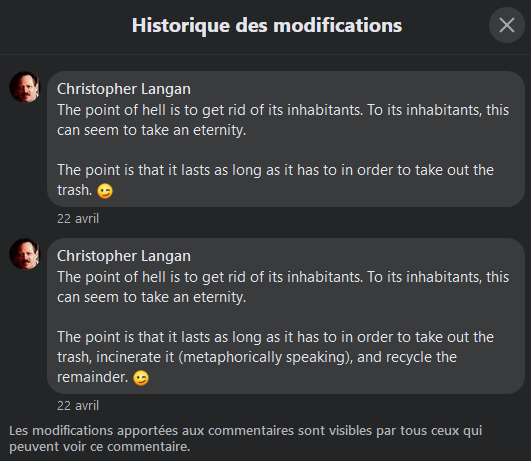
The point is that it lasts as long as it has to in order to take out the trash, incinerate it (metaphorically speaking), and recycle the remainder.[dans les commentaires quelqu’un dit que c’est pareil dans la Bible]
— Chris Langan (2023, April 22)
https://www.facebook.com/groups/ctmurealitytheory/posts/10159296067767486/?comment_id=10160562883192486
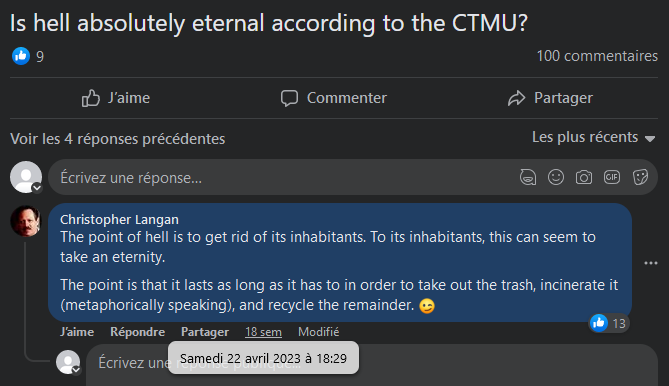
Photos d’écran prise le 29 aout 2023 (donc 22 avril dans l’historique des modification correspond à 2023).
Comment: “Only a sociopathic, psychopathic, amoral entity would cause/allow something it created to culminate in eternal suffering, versus at a minimum de-constructing, or tweaking the creation to culminate in a positive end. Even we humans have a term for someone who would cause or allow such horror. Psychopath. So sad, so frightening that we would perceive the ultimate intelligence, creating entity of all that is in such form.”
Response: …says someone who mocks God at every available opportunity while vainly attempting to hide his hatred of God behind a paper-thin veneer of pseudo-intellectualization worthy of first-rank Satanic buttboys like Richie Dawkins, Dan Dennett, and Sam Harris themselves.
But to dispel your perennial confusion, there’s a purpose behind your impending consignment to hell: separating the wheat from the chaff. What use has the Ultimate Creative Intelligence for ungrateful fair-weather birds who, even while knowing that evil is the logically necessary antithesis of good and pain the necessary complement of pleasure, take every misfortune as a reason to deny and denigrate Him? (Do you see how this works yet?)
By the way, as teloric sensor-controllers of physical reality, we are tools of the Almighty. We are the instrument used by God, within our natural limits, to “de-construct and tweak the creation to culminate in a positive end”. When some of us are not only too infantile to do this correctly, but too stupid and resentful to take direction from someone not quite as stupid (me), this is no fault of God’s.
Mend your ways, son. There is no hope for a blasphemer.
— Chris Langan 2023, April 26
https://www.facebook.com/groups/ctmurealitytheory/posts/10160570657337486/
Question: Q Is Fredrich Nietzsche in hell?
Response: Either Nietzsche is in hell for making people believe that might always makes right and that even truth is beholden to wealth and power - he seems to have contributed greatly to our current level of parasitic divergence - OR Nietzsche has given himself to God heart and soul and paid a huge price for redemption, thus to be rehabilitated in the spirit. (I defer the question of whether Nietzsche had enough left in the tank to pay the fee for this invaluable service.)
— Chris Langan (2024, September 9)
https://www.facebook.com/groups/ctmurealitytheory/posts/10161590484957486/?comment_id=10161591596237486
Quote
Question: “So once someone is damned, that’s it? There is no redemption? I always thought that even the terminal realm can function as hell, but that escape is possible. When does it become inescapable?”
Answer: Hell becomes inescapable when you have been so strongly acquired by evil that you can no longer extricate yourself without help, but cannot obtain the help you need because you’re (1) obviously too far gone to deserve it, (2) unwilling to earn it (it can be quite expensive in terms of effort), or (3) have idiotically gone out of your way to make an enemy of God, Who alone can give it.
God forgives only on the condition that one atone and commit oneself to improvement. One must see one’s position clearly and honestly - fooling oneself is not a viable option, and fooling God is completely out of the question - and there must be sincere remedial effort. If instead there is nothing but repeated backsliding, God realizes that one is not only insincere about atoning, but is making matters worse, further scarring the cosmic ledger with escalating misdeeds and displaying ingratitude for the forgiveness that one has already received.
In effect, one is recognized as something like a drug addict whose drug of choice is evil, and who is simply too lacking in spiritual quality to beat one’s habit, make good on one’s moral debts, and turn over a new leaf. In all likelihood, one will continue to be more trouble than one could possibly be worth.
Salvation is not for those more committed to evil than to atonement and spiritual rehabilitation
— Chris Langan (2023, May 8)
Quote
Let’s put it this way: suicide is never encouraged, but there is no absolute law that decrees punishment for it under all circumstances. Sometimes, for example when one is in protracted constant debilitating pain or despair and nothing can help, suicide may be committed with impunity. In fact, there are certain cases in which it is altruistic, as when one can save many who are worthy by (in effect) killing oneself.
However, if God still has use for you on Earth - if your destiny is not yet fulfilled, or you are still needed for crucial teleological purposes, or your suicide occurs in a way that causes needless harm or extraordinary pain to others - you should make very sure that there’s absolutely no other way. One is not allowed to commit suicide as an act of petulance or sheer self-hatred.
— Chris Langan (2021, May 31)
Quote
Question: Is suicide a sin in the eyes of God?
Answer: Yes if there’s any way you can avoid it, if your situation is at all recoverable, then it’s a sin.
If your situation is unrecoverable, and all it is going to do is cause you excruciating pain from that moment out, if you’ve got terminal cancer and your guts are eaten alive — I know people that have been in this position, who have killed themselves, and I do not blame them.
— Chris Langan, “Is Suicide a Sin?”, YouTube: CTMU Radio (2021, July 31)
Quote
[atheistic activist] “Those are blasphemers and of course destined for eternal damnation.”
— Chris Langan - Atheism vs. Theism https://www.youtube.com/watch?v=6FixOYs1erY
(Chris answers a question at a CTMU Q & A held June, 23rd, 2019)
Quelqu’un demande :
“Hello everyone. It’s me again. I would like to ask a few questions that have been bothering me for weeks, if I may.
Literally speaking, what are heaven, hell, and purgatory like? In heaven, are there mansions, cities, vehicles, roads, trees, seas, etc.? Will there be sports? Are we able to travel to other worlds or galaxies instantly? Will there be sex? Will we keep our memories, names, and faces? Will we be able to watch people on Earth? Are there newly invented video games, books, artworks, and music by citizens of heaven? Are there jobs? Is there an economy, a competition, a hierarchy, and entrepreneurship? Or will we share God’s ultimate essence and knowledge, and therefore have no need for homes, lands, sports, or sex?
Also, what is the CTMU’s view of Houris in Islam? Quran 38:52 “And with them will be maidens of modest gaze and equal age.” Quran 78:33 “and full-bosomed maidens of equal age” are they angelic sexual companions sanctioned by God? How does the CTMU interpret this?
In the CTMU Video “Atheism vs Theism” Chris Langan said that atheistic blasphemers are destined to ‘eternal’ damnation. But in the Curt Jaimungal interview, he said that “Hell is the process of ceasing to exist by being telically unbound, and having your identity destroyed”. Implying that hell is not eternal.
If one is afraid of cockroaches for example, will their hell be a room full of cockroaches? How long will the process of hell last until one is terminated? If you force yourself not to think of things that will create your own hell, what will happen?
For the purgatory, what does it look like, plainly speaking? Is it an underworld where fellow people who were sent there will reside with you? Is it a restart of your life where you are tasked to correct your mistakes in life?
Thank you.”
https://www.facebook.com/groups/ctmurealitytheory/posts/10159745522397486/?__cft__[0]=AZUPDPo132QIk8TFSP7vv76Yw7sXOFOqkT9Mcls46fk1oZ2aWRMRRKADNe77PErQwMPFqIUUyFe87yvOuC2W5cQG0mxMu7R1fKOIGHkC8KCXrMe2qIyYP2Ia7RZHXBt93blvHptWzDrwvGnQeZA74gPU&__tn__=%2CO%2CP-R
Quelqu’un répond :
Mr. Langan wrote this about heaven and hell:
“In addition, an individual human sublanguage might be vectored into an alternate domain dynamically connected to its existence in spacetime. In this scenario, the entity would emerge into an alternate reality based on the interaction between her local level of consciousness and the global level embedding it…i.e., based on the state of her “soul” as just defined. This may be the origin of beliefs regarding heaven, hell, purgatory, limbo and other spiritual realms.”
It makes sense that if a person is good, that entity will emerge in spacetime into an alternate reality in a new body. Where can bodies exist if not on a planet?
Another alternate reality into which the entity would emerge is a place in spacetime where the entity is given the opportunity to change, as long as they have the potential to change.
The third alternate reality is a place for really bad people who will never choose to change. These entities will be pressured until they let go and then they will simply disappear.
Comment: “I’m not sure about souls that are discarded being redistributed back to the universe. They may just be unnecessary and dismissed. Then those souls are connected to… nothing. That sounds pretty hellish. […] But in this model, the telesis of annihilated souls is returned to the universe, and could potentially be “reassembled” into something resembling its former identity, and ultimately return to God.”
Response de Langan: Yes. They are ejected into the bottom limit of existence, UBT. The irony is that as unbound telesis, they have no coherence and thus no identity at all, and because telesis constitutes the existential potential (and thus the ultimate resource) of reality, they cannot resist redistribution (or “reassembly”) by the very God they once hated and opposed.
If a damned telor resists being rendered down to UBT, and part of its identity clings desperately to a scrap of its former existence as a drowning man might cling to the cork of an empty wine bottle, it can be redistributed in any of several ways. It can be sent to a hell conditioned into its own strand of the human identity, a customized hell of its own making, or in principle, even the lowest and most intolerable layer of the reality inhabited by the living, as proposed by the Vedic doctrine of karma and metempsychosis … the layer on which this reality can itself be compared to hell (as noted by Eike).
The G.O.D. Syntactic Metaverse of the CTMU Metaformal System generously makes room for everyone. If it couldn’t, then it wouldn’t be a “Theory of Everything”. 😉
— 2025, January 11
https://www.facebook.com/groups/ctmurealitytheory/posts/10162205459882486/
Bernard de Mathematical Metaphysics en parle dans sa vidéo [Introductory] What follows suicide? Part 1: An open message to anyone contemplating suicide ❤️🔥🚫 (2022, January 29) :
This message is directed to those currently contemplating suicide. I need you to understand something extremely important and relevant : death does not equal nothingness or cessation of experience, death is at once a termination event the decomposition of your body and
a retraction or continuation event. While you are alive, your body is primary, but when you die your mind is primary. The causes of your death, undoubtedly the pain and despair this desperation that you feel will become the main themes of your immediate and indefinite afterlife. My sister struggle, struggles with suicide ideation. The only way to reliably convince anybody who’s thinking these things that they’re not beneficial is through the realization that your own thoughts create your experience after you die. I won’t be able to prove this to you in
the current mental state that you inhabit, but I can personally assure you that this space-time experience that you have that we all share
has an inversion, which you might call time space and that is metaphysical experience, that is mental experience we get tinges of it we
have a mind which is embodied in life, but in the afterlife we have a non-terminal body, we have a body that is mentalized. you can mentally reconfigure the events that you inhabit in time, you’re in a memory bank in time space and you will not be able, your higher self, will not allow you to escape the negative themes of your immediate afterlife the causes of your suicide until you learn why they were so powerful that they caused you to terminate the lifetime. So i need to emphasize again that your suicide will not cause a non-conscious experience, it is not the same as anesthesia or dreamless sleep where you have no experience. Once again i cannot prove this to you, however I can maybe persuade you that existence doesn’t just display itself, but programs itself so your lifetime, no matter how wrong it is gone, can still be reprogrammed or salvaged. The hell you will create for yourself far outweighs the seeming hell that you now inhabit. Think of it as a negative incentive. You don’t want to create your own hell and there’s a definite mechanism, a metaphysical mechanism by which you will create your own hell due to the guilt, regret, shame, pain, that you cause upon your spirit if you suicide. Some of you who watch this video may actually
go through with it in that case I’m addressing a discarnate entity and it is possible to help those who are trapped in their own hells as an incarnate. And that is also why i’m making this video, I’m not just making this video for those who are incarnate but also discarn it, those who suicided and do not yet have respite, they continued to go unrequited, they continued to move aimlessly through painful repetitions because once again when you are in time-space you inhabit a memory bank, and that memory bank is at as wide or as narrow as the lessons you need to learn, and the main lessons of a of an incarnation terminated by suicide are those that are caught the causes of that suicide. So suicide is not the solution, does not cause cessation, cessation is the illusion, cessation is a temporary state of an incarnate entity, but you will not unbind in the way that you think if you die. I can personally assure you that, and therefore I insist that you remain incarnate once again. You know that it’s best to remain incarnate.
Question: “So once someone is damned, that’s it? There is no redemption? I always thought that even the terminal realm can function as hell, but that escape is possible. When does it become inescapable?”
Answer: Hell becomes inescapable when you have been so strongly acquired by evil that you can no longer extricate yourself without help, but cannot obtain the help you need because you’re (1) obviously too far gone to deserve it, (2) unwilling to earn it (it can be quite expensive in terms of effort), or (3) have idiotically gone out of your way to make an enemy of God, Who alone can give it.
God forgives only on the condition that one atone and commit oneself to improvement. One must see one’s position clearly and honestly - fooling oneself is not a viable option, and fooling God is completely out of the question - and there must be sincere remedial effort. If instead there is nothing but repeated backsliding, God realizes that one is not only insincere about atoning, but is making matters worse, further scarring the cosmic ledger with escalating misdeeds and displaying ingratitude for the forgiveness that one has already received.
In effect, one is recognized as something like a drug addict whose drug of choice is evil, and who is simply too lacking in spiritual quality to beat one’s habit, make good on one’s moral debts, and turn over a new leaf. In all likelihood, one will continue to be more trouble than one could possibly be worth.
Salvation is not for those more committed to evil than to atonement and spiritual rehabilitation.
2023, May 6 https://www.facebook.com/groups/ctmurealitytheory/posts/10160596738117486/
Comment: “I was hoping for more of a discussion on repentance. Such as when one makes mistakes how making the right choices covers the sins of your past.”
Response: Making the right choices does not ensure salvation, but merely removes an obstacle to salvation. Merely blocking or “rewriting” guilty or traumatic memories is also insufficient.
“Right choices” must be made in the right spirit for the right reasons, and any rewrite must be transformative on the level of telic recursion (true self-configuration). Memory tricks alone are morally and soteriologically useless. Absolution does not come free, and anyone who tells you otherwise is misleading you.
On the other hand, unforeseen inoptimalities and minor “bad consequences” to which reality can adapt often require less absolution than some believe. God expects us to exercise good moral judgment at all times, but knows that people can be impulsive and sometimes cannot predict the consequences of their actions.
This, after all, is the human condition. Thanks to teleology, reality can adapt to our mistakes (at least up to a point). This is a process with which we do not want to interfere.
2023, May 1 https://www.facebook.com/groups/ctmurealitytheory/posts/10160581765842486/
Question: Chris says Hell is eternal, but doesn’t this imply that eventually, since we are eternal, we will at some point do enough bad things to be damned eternally? We have all of eternity to make good and evil choices and only have to morally fail bad enough during one of zillions of lifetimes.
Chris Langan: Evil is eternal, therefore the “divine subroutine” for dealing with it is eternal. And don’t worry - if, during one of your zillions of lifetimes, you really screw up and are rightfully consigned to hell, not a single one of your other zillions-minus-one lifetimes will give a hoot. In fact, they’ll all be grateful for the decontamination. 😉
— 2023, May 30 https://www.facebook.com/groups/ctmurealitytheory/posts/10160640218667486/?comment_id=10160641364472486
A évaluer ce post d’une personne sur le groupe CTMU :
https://www.facebook.com/groups/ctmurealitytheory/posts/10162204318757486/